If you’re a fan of dark tourism, then you may have heard of London’s most notorious execution site – Tyburn. Located on the edge of the city, Tyburn was once a busy location where criminals and traitors were put to death. Over the years, the site has become largely forgotten, but it’s still worth taking a look at.
Tyburn was first mentioned in the 12th century, and it was used as an execution site until 1783.
Today, there’s not much left of Tyburn. All that remains is a plaque on the side of a building. But it’s still worth visiting, as it gives you a glimpse into London’s dark past.
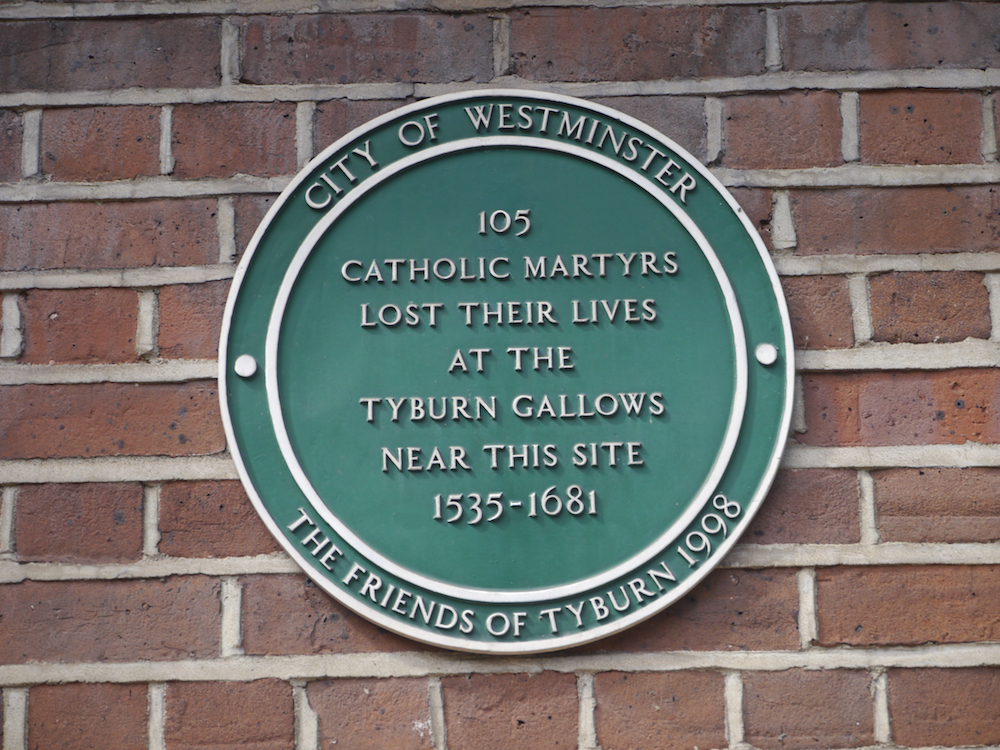
What was Tyburn?
Tyburn was a place of execution located on the outskirts of London. During its peak, Tyburn was a popular spot for public executions – over 100 people were hanged here each year. As for the gallows, the first recorded hanging took place here in 1196 and hangings continued until they were moved to Newgate prison in 1783.
The condemned were brought up Oxford street (then called Tyburn road) to Tyburn Gallows where they met their end and in 1571 a triangular gallows was erected to accommodate more hangings. Up to 24 people could be hanged at once.
Why was it called Tyburn?
Tyburn – meaning ‘place of the elms’ – was a village close to the current location of Marble Arch in central London and so-called for its position adjacent to the Tyburn Brook.
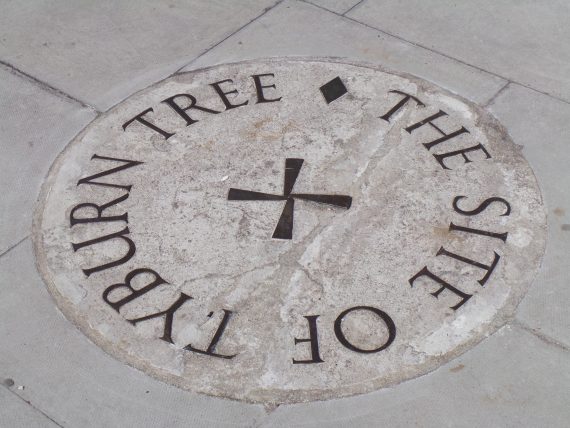
Who executed people at Tyburn ?
The executions at Tyburn were carried out by the public executioner. This was a job that was at times passed down from father to son, and it was considered to be a very prestigious position.
During the 1700s, those found guilty of murder, rape and treason, but also of lesser offences such as poaching, burglary and even criminal damage, could all find themselves on the way to the hangman’s noose. Most punishments were held in public.
Executions were elaborate and shocking affairs, designed to act as a deterrent to those who watched. Prisoners were transported to the gallows along a three-mile route by cart, often followed by a huge, jeering crowd numbering several thousand people. They were then executed in front of these noisy, riotous audiences, and many hangings were more like fairs than serious legal ceremonies.
What crimes were punished at Tyburn?
The majority of people who were executed at Tyburn were criminals or traitors. However, there were also many people who were executed for religious reasons.
A List of People Executed at Tyburn
This is by no means a conclusive list but highlights some of the most prominent executions held at the site:
| Name | Date of Execution | Known For | Charge |
| William Fitz Osbert | 1196 | Uprising of the Poor | Treason |
| Jack Sheppard | 16 November 1724 | Burglar and Prison Escapee | Theft |
| Claude Duval | 21 January 1670 | French Highwayman | Robbery |
| Edmund Campion | 1 December 1581 | Catholic Martyr | Treason |
| Francis Dereham | 10 December 1541 | Lover of Catherine Howard | Treason |
| Thomas Culpeper | 10 December 1541 | Lover of Catherine Howard | Treason |
| William Spiggot | 11 February 1721 | Highwayman | Robbery |
| Elizabeth Brownrigg | 14 September 1767 | Abuse of Domestic Staff | Murder |
| Elizabeth Barton (Nun) | 20 April 1534 | prophesied Henry VIII Death | Treason |
| Robert Southwell | 21 February 1595 | Catholic Martyr | Treason |
| William Chaloner | 23 March 1699 | Counterfeiter | Treason |
| Perkin Warbeck | 23 November 1499 | Pretender Duke of York | Treason |
| John Austin | 3 November 1783 | Highwayman | Murder |
| William Leech of Fulletby | 8 May 1543 | Pilgrimage of Grace | Treason |
* *On 30 January 1661, by the order of King Charles II, Oliver Cromwell and Henry Ireton were posthumously executed following the exhumation of their bodies from Westminster Abbey.
Who was the Last Person Executed at Tyburn?
On 3 November 1783 highwayman John Austin became the last man to be executed at Tyburn, marking the end of an infamous 600-year history. John Austin was sentenced to death in 1783 for the murder of labourer John Kent and became the last man to be hanged at the site.
After this date Newgate prison carried out the executions on a scaffold called “New Drop”.
Link/cite this page
If you use any of the content on this page in your own work, please use the code below to cite this page as the source of the content.
Link will appear as Hanson, Marilee. "Tyburn – London’s Most Notorious Execution Site" https://englishhistory.net/tyburn/, March 7, 2022