The shield was very important piece of defensive armor of medieval knights before the advent of plate armor. It was used as a protective weapon and often intercepted attacks of bows and arrows, swords and even blows. Shield was worn on the arm or shoulder and held in hand during hand-to-hand combat. The form and design changed through time from long, reversed teardrop shape of the Kite shield which was commonly used from the 10th to the 12th centuries to the smaller, triangular Heater shield and the round Buckler. However, the knights ceased to use the shields after the introduction of plate armor, while lightly armored troops continued to use the shields.
Medieval shields worn by the knights in the battles greatly influenced the development of coat of arms and heraldry. Patterned and ornamented shields were often crucial for identification on battlefields, while armorial insignia in the 13th century also became an instrument of identification of an individual or noble family impressed in sealing wax on documents, carved on family tombs and flown as a banner on castles and manor houses.
Coat of Arms
Coat of arms came to be considered a legal property transmitted from father to son in many medieval European countries. Ancestral arms of other descendants featured some changes such as addition of a distinguishing charge, while unmarried female descendants borne ancestral coat of arms in a shape of a lozenge or rhombus. A descendant of prominent parents sometimes borne ancestral coat of arms of both parents split into two parts.
The use of coat of arms was strictly regulated and overseen by the herald, a professional officer of arms. Therefore the study of coat of arms is called heraldry. The rules of design and display of coat of arms greatly varied from country to country but there were some common standards such as the basic consisting elements and seven basic colors or tinctures (gold, white or silver (argent), red, blue, green, purple and black).
The main constituent of the coat of arms is the shield or escutcheon the shape of which clearly indicates the influence of medieval shields used by knights in the battles although other shapes were possible as well. In contrary to the shape, patterns or division of the field and charges (image occupying the field) of the coat of arms were strictly regulated.
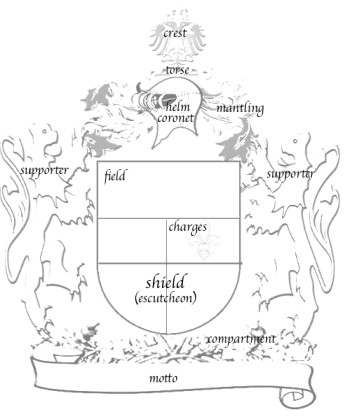
On either side of the shield are the supporters, real or imaginary figures depicted holding it up. Under the shield and the supporters is a design called the compartment depicting some sort of landscape. Above the shield is placed the helmet or some other headgear such as crown or coronet tied with mantling, a drapery which was worn by knights from their helmets as a protective cloth covering. Around the top of the helm is the torse also referred as wreath, a twisted roll of protective cloth worn over helmets depicted in two colors, usually in the same pair of colors as the mantle. On the top of the helmet is the crest which initially continued into the mantling. Bellow the shield is usually the motto, a phrase or sentence on a scroll.
Link/cite this page
If you use any of the content on this page in your own work, please use the code below to cite this page as the source of the content.
Link will appear as Hanson, Marilee. "Medieval Shields and Heraldry" https://englishhistory.net/middle-ages/shields/, January 12, 2022