‘Is it not extraordinary? When among Men I have no evil thoughts, no malice, no spleen – I can listen and from every one I can learn – my hands are in my pockets I am free from all suspicion and comfortable. When I am among Women I have evil thoughts, malice, spleen – I cannot speak or be silent – I am full of Suspicions and therefore listen to no thing – I am in a hurry to be gone – You must be charitable and put all this perversity to my being disappointed since Boyhood – ….I must absolutely get over this, – but how? The only way is to find the root of the evil, and so cure it.’ John Keats, in a letter to Benjamin Bailey, July 1818
‘Nothing strikes me so forcibly with a sense of the rediculous as love – A Man in love I do think cuts the sorryest figure in the world – Even when I know a poor fool to be really in pain about it, I could burst out laughing in his face – His pathetic visage becomes irresistible.’ John Keats, in a letter to his brother George, September 1819
Biography Of Fanny Brawne
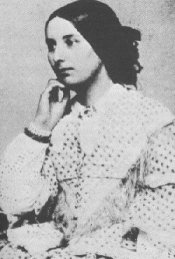
Ambrotype of Fanny Brawne
On 8 December 1865, the front page of the London Times included the following obituary: ‘On the 4 inst., at 34 Coleshill-street, Eaton-square, Frances, the wife of Louis Lindon, Esq. Friends will kindly accept this intimation.’ The 65 year old Mrs Lindon was survived by her husband, a sales agent twelve years her junior, and three children. The eldest, 31 year old Edmund was in government service; 27 year old Herbert and 21 year old Margaret still lived at home. Their mother’s death naturally affected them, but it was otherwise of interest only to those with memories of Hampstead forty-six years ago. For it was there, in the autumn of 1818, that Frances Lindon had been known as Fanny Brawne. And it was there that she met a struggling young poet named John Keats. The anonymous Mrs Lindon was, in fact, the mysterious, unnamed beloved of the now famous Keats.
It was seven years after her death before Fanny’s identity became known. Though she had told her children of her romance with Keats, and shown them her collection of his books and love letters, she had also made them promise to never tell their father. But when Louis Lindon died in 1872, Fanny’s children (led primarily by Herbert) were finally able to profit from their mother’s story.
And profit they did. Though Keats had died in 1821, just 25 years old and largely unknown, the resulting years had witnessed a belated recognition of his genius. He was now considered among the greatest English poets. His works sold briskly and, in 1848, the first biography of Keats was published. Written by Richard Monckton Milnes with the aid of several of Keats’s friends, it nevertheless angered many others. Like Percy Shelley’s elegy ‘Adonais’, Milnes’s biography created an image of Keats as a sickly dreamer done to death by bad reviews. It was a sentimental portrait and psychologically false. And though it mentioned Keats’s engagement to a young lady, it never named the lady in question.
Fanny had witnessed the growth of Keats’s reputation; perhaps she had read the numerous books which eulogized him. But she never revealed herself, nor took a noteworthy interest in his life. Her husband knew only that she and the poet had met as neighbors in Hampstead. Fanny never told him otherwise.
But she had kept Keats’s love letters to her, over three dozen of them; many were mere notes, others lengthy chronicles of his devotion, others jealous ramblings which revealed a heretofore new (and, to his admirers, unpleasant) aspect of Keats’s character. These letters would later be celebrated as among the most beautiful ever written. But in the 1870s, matters were quite different. Fanny clearly believed they were valuable, or else she would never have given them to her children. Yet what sort of value did she envision? Did she think they would aid scholarship? Or give new insight into Keats’s life? Or did she intend for her children to sell them and literally profit from her long ago romance? We do not know the answer. We do know, however, that, upon his father’s death, Herbert Lindon immediately sought to sell the letters.
And so while no one considered the death of 65 year old Frances Lindon to be noteworthy, the name of John Keats’s beloved was noteworthy indeed. Thus began the contradictory legacy of Fanny Brawne.
‘Shall I give you Miss Brawne? She is about my height with a fine style of countenance of the lengthened sort – she wants sentiment in every feature – she manages to make her hair look well – her nostrils are fine though a little painful – her mouth is bad and good – her Profile is better than her full-face which indeed is not full but pale and thin without showing any bone – her shape is very graceful and so are her movements – Her arms are good her hands badish – her feet tolerable…. She is not seventeen – but she is ignorant – monstrous in her behavior flying out in all directions, calling people such names that I was forced lately to make use of the term Minx – this I think not from any innate vice but from a penchant she has for acting stylishly. I am however tired of such style and shall decline any more of it.’ John Keats, in a letter to his brother George, mid-December 1818
Keats and Fanny first met in the midst of great personal turmoil for the poet. His youngest brother Tom was desperately ill with tuberculosis; it had already killed their mother, would soon claim Tom and later Keats himself. And when their relationship began, its greatest obstacle was not illness but money.
It was the autumn of 1818. Keats had recently returned from a walking tour of Scotland with his friend Charles Brown. Brown had rented out his half of the double house called Wentworth Place to the Brawne family. When he returned, the Brawnes moved to Elm Cottage, a brief walk away. But while they had lived at Wentworth Place, they had become close friends with Brown’s neighbors (and Keats’s friends), the kindly Dilke family. The Dilkes had spoken often of Keats, praising him in the highest terms. And so when the Brawne family finally met the esteemed young Mr Keats, they were prepared to like him.
Mrs Brawne was widowed and had three children – 18 year old Fanny, 14 year old son Sam and 9 year old daughter Margaret. The teenaged Fanny was not considered beautiful, but she was spirited and kind. She was also a realist and immensely practical, perhaps as a result of her family’s straitened circumstances. She took great care with her appearance and enjoyed flirting with young admirers. As Hampstead was close to an army barracks, there were numerous military dances throughout the year. Fanny was a popular participant. When they first met, Keats was struck by her coquettish sense of fun, and it later pricked his jealousy too often for comfort. My greatest torment since I have known you has been the fear of you being a little inclined to the Cressid,’ he would tell her later, referring to Chaucer’s infamous flirt.
They met at the Dilkes’ home, as Fanny later recalled, and ‘[Keats’s] conversation was in the highest degree interesting and his spirits good, excepting at moments when anxiety regarding his brother’s health dejected them.’ Indeed, Keats, whatever his first impressions of young Miss Brawne, was too caught up with his younger brother’s decline to ponder any attraction. By the end of November, with Tom close to death, Keats spent nearly every waking moment at Tom’s bedside. The little rooms at Well Walk, once the scene of close companionship for the Keats brothers, were now haunted with disappointment, despair and grief. When Tom died on 1 December, Keats was worn and numb. The memory of Tom’s terrible, lingering illness would never be forgotten.
But he at least had a welcome distraction in Fanny Brawne. Eager to escape Well Walk, he gladly accepted Brown’s invitation to share Wentworth Place with him. This was not charity on Brown’s part; Keats paid him the normal rate for lodging. Since he now lived next door to the Dilkes, Keats visited with more frequency. And each time, the brown-haired, blue-eyed Fanny made a greater impression. She both confused and exasperated Keats, and therein lay her attraction. He simply could not understand her. In mid-December, two weeks after Tom’s death, he wrote a long letter to George and Georgiana in America. Its contents spanned a fortnight and Fanny is notably mentioned: ‘Mrs Brawne who took Brown’s house for the summer still resides in Hampstead. She is a very nice woman and her daughter senior is I think beautiful, elegant, graceful, silly, fashionable and strange. We have a little tiff now and then – and she behaves a little better, or I must have sheered off.’ And later the poet gave the more vivid description cited at the top of this section.
Keats was able to occasionally dismiss Fanny from his mind. She rates only a passing mention in a mid-February letter to George (he and Fanny have an occasional ‘chat and a tiff’). Poetry had once more become a consuming passion. But it would only be a matter of time before both Fanny and poetry occupied positions of equal importance in his life. We know little of Fanny’s literary inclinations, but Keats – who had once commented, ‘I have met with women who I really think would like to be married to a Poem and to be given away by a Novel’ – was not seeking poetic validation from Fanny. Though she read his work, and admired it, she did not participate in its creation.

Miniature oil portrait of John Keats, 1819
Throughout the winter of 1819, Keats worked for hours at his desk in Hampstead. In January, The Eve of St Agnes was completed and, a month later, The Eve of St Mark. And Keats also worked on the ambitious Hyperion until early spring, leaving it deliberately unfinished.
On 3 April 1819, he was suddenly forced into even closer quarters with the baffling Miss Brawne. The Dilkes decided to move to the city center and rented their half of Wentworth Place to Mrs Brawne and her children. Fanny was now a next door neighbor and her presence came close to intoxicating Keats. From April onward, their romance blossomed. Keats would interrupt his serious poetry to write quick sonnets to Fanny, including the famous Bright Star, would I were steadfast as thou art. Most of these works dwell upon her physical charms, but they also celebrate the enjoyment and abandon he found in her company. It was inevitable that his first love affair would consume him. In turn, he was given new impetus, – new inspiration, – new insight into his own emotions and the world itself. His poetry began to reflect this new maturity and power.
In late April, he began composing one of his best-loved works, La Belle Dame Sans Merci. The story of an enchantress and the knight she lures to his doom, it is an evocative and beautiful work, justly celebrated. But even it gives no hint of the great works to come; Keats himself considered it mere light verse and, in a letter to George, dismissed it with a joke. Then, in the space of a few weeks, he composed three of the most beautiful works of poetry ever written – Ode on a Grecian Urn, Ode to a Nightingale and Ode on Melancholy.
The story of the composition of Ode to a Nightingale, as well as an image of Keats’s original draft, can be read at the Keats: Manuscripts page.
These works remain the ultimate expression of Keats’s genius and secured his reputation as a great poet. But this vindication of his early promise did not result in immediate acclaim. There was no fanfare, or even immediate publication. Instead, there were more long hours at work, stolen moments with Fanny, and Brown’s cheerful company. Mrs Brawne had by now realized the serious course of Keats and Fanny’s relationship; she could not have been very pleased. Keats was a kind and intelligent young man, but he was poor and his chosen career offered little hope of success. But her own good nature could not prevent a love match. She grew fond of the poet and later nursed him through his illness.
But Brown was not happy about the relationship. He disliked Fanny, perhaps out of jealousy because she consumed much of Keats’s time and thought. Perhaps, too, he understood the depth of Keats’s feelings and Fanny’s casual, flirtatious attitude with other men (Brown included) indicated a far more shallow attachment on her part. He did not encourage their courtship and, amongst the poet’s friends (with the exception of the Dilkes), Fanny was viewed somewhat askance. They noticed her teasing behavior and the depression and jealousy it aroused in Keats. Distracted by such antics, how could Keats write?
For his part, Keats was not unaware of their friendly concern but knew himself too well to be bothered. He had confessed his extreme nature to Bailey over two years past and had come to relish it; it provided the force for his poetry (‘the excellence of every Art is its intensity,’ he once wrote.)
He continued writing, completing the Ode on Indolence probably in early June. Its epigraph is from Matthew 6:28, in which Jesus urges his followers not to be anxious: ‘Consider the lilies of the field, how they grow; they toil not, neither do they spin.’ And its inspiration was found in a letter he had begun to George and Georgiana in mid-March. He had written:
‘This morning I am in a sort of temper indolent and supremely careless…. Neither Poetry, nor Ambition, nor Love have any alertness of countenance as they pass by me: they seem rather like three figures on a greek vase – a Man and two women – whom no one but myself could distinguish in their disguisement. This is the only happiness; and is a rare instance of advantage in the body overpowering the Mind.’
The Ode to Psyche was completed next. When summer finally arrived, Keats had gone through a period of sustained achievement. The pressing problem of money could not be forgotten, of course, and it drove him to Shanklin in the Isle of Wight for the summer. The holiday in cheap lodgings saved money but it also allowed the poet uninterrupted time to write.
He worked on part one of Lamia and Otho the Great, a play which Brown encouraged as a way for he and Keats to enter the playwriting business. It was their hope that plays might be more profitable than poetry. As for Lamia, it is a beautiful work, and starkly embodies Keats’s comment to Woodhouse: ‘Women love to be forced to do a thing, by a fine fellow.’ The poem is a realistic depiction of love as a violent and destructive force, often contradictory and inexplicable. The treatment of sexuality is also striking. For those later shocked by the intensity of Keats’s love letters to Fanny Brawne, Lamia reveals a poet reveling in the complexities of love.
In August, Keats left the Isle of Wight for Winchester. Here he wrote the second part of Lamia and the beautiful ode To Autumn. He returned to Hampstead in October and was soon officially engaged to Fanny. Their meeting after his three months’ absence overwhelmed Keats; ‘you dazzled me’, he wrote to Fanny. She was still a tease and deliberately stoked his jealousy. The poet remained torn between his work and his love. The holiday peace which had aided his poetry disappeared the moment he saw Fanny. Marriage was now their only option.
The prospect of marriage brought fresh scrutiny of his financial woes. He had to make money from writing; even a small success would be welcome. He met with his publishers again in November and plans were made for another book of poems. Keats also borrowed numerous works of sixteenth-century history from Taylor to research the Earl of Leicester. Brown’s earlier push towards playwriting for profit had helped spark a new ambition in Keats. Now he planned to write a play about Elizabeth I’s true love, and the choice of Shakespeare‘s time was perhaps deliberate. Above all else, Keats admired Shakespeare’s universality, his realism, the ability to create high drama from human emotion rather than outlandish deeds. He now intended to become a playwright like his idol, using the years of poetry as a school of sorts, preparation for the real achievements which lay ahead. He wrote to Taylor that he hoped to finish soon, ‘if God should spare me.’
In January, his brother George returned from America to borrow more money from Keats, who could ill afford it. He also came to an agreement with his guardian over the final settlement of his grandmother’s estate. The end result was very little and Keats gave most of it to George.
There was a new distance between the brothers. Though younger, George was married and settling into his own business while Keats could not afford to marry Fanny. ‘George ought not to have done this,’ Keats remarked to Fanny about the loan, ‘he should have reflected that I wish to marry myself – but I suppose having a family to provide for makes a man selfish.’ To Brown he was more bitter: ‘Brown, he ought not to have asked me.’ George himself told his brother, ‘You, John, have so many friends, they will be sure to take care of you!’
But Keats knew his only hope of marrying Fanny was to succeed in his literary career. In February 1820, however, their future was threatened by something more ominous than poverty.
The month had begun badly, with a portent of worse to come. Brown’s maid told him that Keats was taking laudanum; when confronted, Keats promised to stop. But while Brown believed Keats took it ‘to keep up his spirits’, the truth was that he used it as a normal pain-killer. The occasional sore throat and cough which had troubled him was still dismissed as a mere cold, but a new tightness in his chest had begun. And on 3 February, Keats had his first lung hemorrhage. The story of this tragic event was later recalled by Charles Brown, who never forgot it. Keats had gown into the city to visit friends and returned at 11 o’clock. As it was cheapest to ride outside the stagecoach, he did so, but he lacked a warm coat and the night was bitterly cold and windy. He arrived at Brown’s house in a sort of fever. His friend immediately realized Keats was ill and sent him upstairs to bed. Brown then brought him a glass of spirits. As he entered the room, he heard Keats cough. It was just a slight cough, but Keats said: ‘That is blood from my mouth.’ There was a drop of blood upon his bedsheet. He said to Brown, ‘Bring me the candle, Brown, and let me see this blood.’ Both men looked upon it for a moment; then Keats looked up at his friend calmly and said, ‘I know the color of that blood; it is arterial blood. I cannot be deceived in that color. That drop of blood is my death warrant. I must die.’
Brown never forgot those words, nor the otherworldly calm with which Keats spoke. His friend’s medical training and nursing of Tom revealed the illness for what it was – there could be no doubt, no comforting pretense.
Later that evening there was a second hemorrhage, far greater and more dangerous than the first. This was typical of tubercular patients and the second bleeding was often fatal. Keats could not help but cough violently. The cough, in turn, enlarged the area of bleeding and the spread of blood into his mouth was so sudden and thick that he thought he would die then. He said to Brown, ‘This is unfortunate.’ Luckily, he survived the bleeding and was able to rest at Brown’s home for the next several weeks.
The illness spurred him to write a batch of letters to his younger sister Fanny, still a ward in their guardian Richard Abbey’s home. George had not even visited Fanny while in England, but Keats thought of her often. Now that he was ill and reflective, he felt guilty for not visiting her more. ‘You have no one in the world besides me who would sacrifice any thing for you – I feel myself the only Protector you have,’ he wrote to her. He kept both she and Fanny Brawne apprised of his illness, though he was careful to be cheerful and light-hearted. He was being treated by the surgeon GR Rodd, whom Brown had summoned that fateful night. Rodd prescribed a light diet and bleeding. Keats noted the weakness caused by the bleeding, but followed orders.
At this point, he feared the worst but tried to believe the best. It had been an unusually cold winter; many of his friends had fallen ill. Perhaps there was a possibility he would recover. But the weakness which had settled into him was too pervasive and heavy; it laid upon him. Within a week, he could only manage a quarter of an hour in the garden. And his medical training countered any optimism; he had bled so heavily that first night that his lungs must be damaged. It was realistically impossible to believe otherwise.
There was no hope for it and so he wrote to Fanny, telling her she was free to break their engagement. She passionately refused and Keats could not deny his relief: ‘How hurt I should have been had you ever acceded to what is, notwithstanding, very reasonable!’
Still, they were advised by friends and the doctor to keep their visits to a minimum. Keats was to avoid any heightened emotion, any upset. It was Charles Brown who nursed him diligently, doing his best to keep the poet calm and Fanny safely next door.
Keats wrote to his friend James Rice, who had also experienced serious illness:
‘How astonishingly does the chance of leaving the world impress a sense of its natural beauties on us. Like poor Falstaff, though I do not babble, I think of green fields. I muse with the greatest affection on every flower I have known from my infancy – their shapes and colours are as new to me as if I had just created them with a superhuman fancy -…. It is because they are connected with the most thoughtless and happiest moments of our Lives.’
And in an undated note from the same period, he mused: ”’If I should die’, said I to myself, ‘I have left no immortal work behind me – nothing to make my friends proud of my memory – but I have lov’d the principle of beauty in all things, and if I had had time I would have made myself remember’d.”’
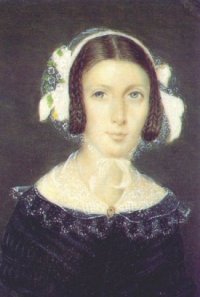
Miniature portrait of Fanny Brawne
There was new impetus for poetry, then, including a gift from BW Procter, whom Keats’s champion Leigh Hunt had compared to Keats. And his publisher John Taylor pushed him to select and revise poems for the press. Keats turned to the task with some of his old enthusiasm. But this proved to be too much for his precarious health. The contrast between the powerful writing of a mere few months before with his now weakened and helpless state depressed him. It could not be otherwise. His ill health, the endless fever and weakness, could not be ignored.
Also, Brown’s dislike of Fanny was now open and unavoidable. It was exacerbated by Brown’s own scandalous behavior. His housemaid was pregnant with his child and he did not want female visitors to his home. But Fanny, who quickly realized the situation, was determined to visit Keats. She did so as often as possible and, against the advice of her mother, sent him a brief note every night.
The emotional situation would have been difficult even for someone in perfect health. But on 6 March, Keats had a new and dangerous symptom. That night, he experienced violent palpitations of the heart. Rodd recommended a specialist, Dr Robert Bree, who declared Keats to be suffering from a primarily hysterical illness. He did not dismiss the earlier bleeding, but believed it was caused by anxiety. Brown wrote in relief to Taylor that ‘there is no pulmonary affection, no organic defect whatever, – the disease is on his mind.’
This diagnosis merely reinforced the opinion amongst Keats’s friends that Fanny was, quite literally, bad for his health. Keats’s exquisite sensitivity, his imaginative sympathy (remember Haydon’s remark that Keats could not look at a tree without seeing a dryad), – the qualities which made him a great poet also made him far too susceptible to the rigors of young love. Fanny might behave as light-hearted and free as before she met Keats, yet her newest admirer was quite different from the others. Keats’s friends knew this, but did Fanny?
Whether Keats believed Bree’s new diagnosis is unclear. He had close experience with tubercular patients and extensive medical knowledge of his own. But Bree removed him from the starvation diet, prescribing wine and meat to build strength. He also gave Keats sedatives for his anxiety, primarily opium. This helped ease the pain and tightness of his chest. With a normal diet and pain medication, Keats regained some of his old strength. He was able to work on the volume of poems for Taylor and passed some two months of relative peace. His letters to Fanny were more confident and playful. He was even able to attend an exhibit of his artist friend Benjamin Haydon’s work in Piccadilly, walking over eight miles there and back..
Brown typically rented out his home during the summer when rents were highest. He was especially eager to do so that summer since the impending birth of his child and support for its mother put a strain on his finances. He cast about for somewhere for Keats to stay, and it was Leigh Hunt who came to the rescue. Hunt’s wife was also a consumptive; it is probable that he understood the seriousness of Keats’s condition. But he also realized that everyone, including Keats, had committed to pretending that Keats was not truly ill, and rest and emotional tranquility would cure him. Hunt’s own financial problems had driven him just outside Hampstead, and he arranged for Keats to live just a few doors away.
The rent was much cheaper than in Hampstead proper but still within a mile of Fanny’s home. It was also still close to town, so that Keats could continue to advise Taylor and Hessey on his book. Hunt promised to keep close watch upon his friend. And Brown, despite his own financial troubles, lent Keats £50 for summer expenses; he borrowed the money from his lawyer. He also paid Keats’s moving expenses and first weeks’ rent. All of this was on top of forgiving Keats’s household expenses for the last several weeks at his home. Brown then left for Scotland, with Keats accompanying him to Gravesend. The two friends never met again.
The new lodgings had one unbearable defect for Keats – they lacked Fanny. She was just a mile away, but it might as well have been ten miles. She could not visit his lodgings without a chaperone and they could not meet at Hunt’s noisy home. During his illness at Hampstead, even when apart, he could still glimpse her occasionally, going about her errands. And they had met quite often and exchanged notes. Now she was too far away to glimpse or hear. Her mother came to check on him, but we have no evidence that Fanny came. Keats himself returned to Wentworth Place just once, to pick up letters for Brown. The strain of seeing Fanny and then parting was too great. He wondered ceaselessly if her feelings had changed, if she still loved him, and his emotional distress was exacerbated by his physical decline. His long-standing distrust of women, his disdain for their flirtatious and teasing behavior, reawakened old suspicions. He now played the role of jealous lover.
His mood darkened so that even occasional visits to town went badly. The young artist Joseph Severn paid the most visits to Keats. But their walks on the Heath grew short as Keats’s depression lingered. At the end of May, he learned of Fanny’s unchaperoned visit to the Dilke home for a party and dance. He could not bear it, and wrote accusatory letters to her. Fanny responded with lively good sense and Keats was soon contrite. ‘Do not believe me such a vulgar fellow,’ he wrote to her. ‘I will be as patient in illness and as believing in Love as I am able.’ But this new resolve could not hold; his own nature worked against it.
He spent June correcting the proofs of his new book. It was a cause for happiness, but as he wrote to Brown, ‘My book is coming out with very low hopes, though not spirits on my part.’ In mid-June he visited the city and was invited to a dinner with Wordsworth. Keats did not dare risk the night air, but he would have been pleased to hear Wordsworth’s praise. Keats was ‘a youth of promise too great for the sorry company he keeps’, the older poet remarked. On 22 June, a letter arrived from his sister Fanny; there was a new problem with the Abbeys. Keats prepared to visit but, on the way to the town coach, a new fit of bleeding occurred. Dr Bree was wrong after all. This was not a nervous condition, but a real and serious physical problem.
With a mouth full of blood, he returned to his rooms. He later went to Hunt’s home at 13 Mortimer Terrace but told them nothing. The Gisbornes, friends of Percy Shelley, were visiting as well and Mrs Gisborne described an ’emaciated’ Keats in her journal the following day:
‘Yesterday evening we drank tea at Mr Hunt’s…. Mr Keats was introduced to us the same evening; he had lately been ill also, and spoke but little; the Endymion was not mentioned, this person might not be its author; but on observing his countenance and his eyes I persuaded myself that he was the very person. We talked of music, and of Italian and English singing; I mentioned that Farinelli had the art of taking breath imperceptibly, while he continued to hold one single note, alternately swelling out and diminishing the power of his voice like waves. Keats observed that this must in some degree be painful to the hearer, as when a diver descends into the hidden depths of the sea you feel an apprehension lest he may never rise again. These may not be his exact words as he spoke in a low tone.’
The subdued and distracted Keats returned home that night to a replay of the February bleeding. He had a second and far more dangerous hemorrhage. His landlady summoned Hunt and Keats was moved to the Hunt household. Dr George Darling was summoned to his bedside. Darling believed Keats was consumptive, and he prescribed the same light diet and blood-letting as Rodd. Bree’s treatment, despite its false emphasis upon Keats’s emotional health, had at least allowed him solid meals and no bleeding. But now regular bleeding and a scanty diet took their toll upon his failing health.
Hunt attempted to lift his spirits but it was hopeless. His household – five unruly children and a sick wife – was too noisy and troublesome. Keats’s despondency found echo in his beloved Shakespeare, as he wrote to Fanny:
‘Shakespeare always sums up matters in the most sovereign manner. Hamlet’s heart was full of such Misery as mine is when he said to Ophelia ‘Go to a Nunnery, go go!’ Indeed I should like to give up the matter at once – I should like to die. I am sickened at the brute world which you are smiling with.’
His thoughts dwelt constantly upon thwarted love, at happiness snatched away just as it came near:
‘If my health would bear it, I could write a Poem which I have in my head, which would be a consolation for people in such a situation as mine. I would show some one in Love as I am, with a person living in such Liberty as you do.’
But despondency could be alleviated by something which Keats neither expected nor dared to imagine – positive critical reviews of his new book. The book was printed in the last week of June 1820 and was a far greater success than his earlier work. Indeed, its reception was as positive as any poet could wish. Even Blackwood’s, which had earlier savaged his work, was somewhat impressed. Keats knew of the strong sales, writing, ‘My book has had a good success among literary people, and, I believe, has a moderate sale.’ But his poor health prevented any real celebration.
His friends had long suggested a trip to Italy to recover his health. It has first been viewed as a chance to calm his spirits and allow needed rest. But now it was recognized as a last chance at recovery. Such trips to warmer climates were common for tubercular patients.
Meanwhile, an experience at Hunt’s drove Keats back to Hampstead, but in a most heartbreaking way. A letter from Fanny was mistakenly opened before being given to Keats. He was immediately and irrationally upset; he cried for hours and told a shocked Hunt that his heart was breaking. His battle with the world had finally broken his spirit. Keats left for Hampstead, walking along Well Walk and past the rooms where Tom had died. He was glimpsed at the end of the street, sobbing into his handkerchief. Finally, he arrived at the Brawnes’ rented rooms at Wentworth Place. He was so ill, exhausted, and emaciated that Mrs Brawne flouted society and admitted him. He would spend the next month there and later say it was the happiest time of his life.
That weekend he sent an apology to Hunt and notes to his sister and Taylor. He asked his publisher for any information about a trip to Italy, its cost and when boats sailed; he also sent Taylor a will of sorts, leaving all his things to Taylor & Brown. In this way, he hoped to settle his debts with both men.
Taylor was generous as always, and more than eager to help Keats. He researched the matter and found that Rome was the best place for medical care. A kind Scottish doctor, James Clark, practiced there and Taylor could write ahead to secure his services. Clark already owned Endymion and the 1820 volume of poems. He knew of and admired Keats.
The success of the last volume of poems allowed Taylor to advance money for the trip. He visited Keats on Friday, 18 August and they discussed matters. Keats both dreaded and anticipated the trip. He did not dare believe he would return. The parting from Fanny, with whom he now lived, would be heartbreaking.
He wrote to Brown, asking his closest friend to accompany him to Rome. Some biographers have implied that Brown refused, remaining in Scotland until it was too late to accompany Keats. In truth, he left Scotland early and hurried back to London only to discover his friend already departed. Whether he wrote to Keats to accept his offer, we do not know.
The journey was made more pressing by the end of August. Keats had another severe hemorrhage and was now confined to bed, nursed diligently by Fanny. Haydon visited and found his friend ‘to be going out of the world with a contempt for this and no hopes of the other.’ The ironic fulfillment of his poetic and romantic dreams – success at last, and the chance to marry Fanny – consumed him. Happiness could be his at last, if not for this inherited illness. Memories of Tom’s lingering end fought with the desire to stay near Fanny. In the end, he could only take his friends’ advice and the final hope of a recovery in Italy.
But who would accompany him? Brown had not returned. His other friends had ready excuses; Hunt, Haslam, and Dilke had families and Haydon was busy. On 12 September, Severn was approached. The young painter had always admired Keats. He had just won the Academy Gold Medal which would allow for a traveling fellowship. A season in Rome could benefit Keats’s health and Severn’s painting. With the enthusiastic and impulsive kindness which marked his character, Severn accepted the charge. Though young and inexperienced in life, he proved to be an admirable nurse for the ailing poet.
The final goodbye to Fanny can only be surmised. But it is clear from surviving letters that she and Keats had fallen even more deeply in love during that last month. The task of nursing him could have destroyed her affection, but instead it was deepened and strengthened. They exchanged gifts; she included a journal and paper so he could write to her and lined his traveling cap with silk. She also gave him an oval marble which she used to cool her hands while sewing which could also be used by a fevered patient. This marble, which Fanny herself had clasped so often, would rarely leave Keats’s hands in Rome. He did not write to her – he dared not – nor would he open her letters; the pain was too near. But he held the marble constantly.
‘I know of nothing comparable with them in English literature – know nothing that is so unselfish, so longing, so adoring – nothing that is so mad, so pitiful, so utterly weak and wretched. John Keats was a great genius, but he had not one particle of common-sense – for himself. Few men of genius ever do have…. Why, a boy might have told Keats that the way to woo and win a woman was not to bare his heart before her, as he did before Fanny Brawne, and not to let her know, as he did, that he was her captive. If he had had the least glimmer of common-sense, he never would have surrendered at discretion.’ RH Stoddard on the publication of Keats’s love letters to Fanny Brawne, April 1878
Keats and Severn sailed on 17 September 1820. Severn had not grasped the seriousness of Keats’s illness and believed the trip to Rome was a chance for recovery. They shared quarters with two women, with a screen dividing the beds. One of the women, eighteen year old Miss Cotterell, was the classic consumptive, wasted, weak, and glassy-eyed, pale but with a feverish blush on her cheeks and racked by a brutal cough. In contrast, Keats was still not officially diagnosed and often seemed the picture of health. It was only a week or so into the voyage that Severn began to suspect the truth. For all of his outward signs of bonhomie, the poet grew feverish during the night, coughed hard and brought up blood. Perhaps most disturbing to the gregarious and cheerful Severn, Keats’s physical anguish was consuming him mentally. He often stood by himself, staring silently over the dark water. As Severn wrote, ‘He was often so distraught, with moreover so sad a look in his eyes, sometimes a starved, haunting expression that it bewildered me.’
The kind-hearted Severn was torn. He regarded Keats with something approaching awe, well aware of the younger man’s talent – aware, too, that a few London friends thought Keats would become a rival to Shakespeare. But during the voyage Severn found Keats withdrawn and difficult to reach. The silence unnerved Severn but it was better than Keats’s sudden and unexpected outpouring of feeling when they arrived at Naples. Suddenly, Severn became aware of another reason for Keats’s mental anguish – it wasn’t simply his ill health, it was also an ill-fated love affair with a young woman in London named Fanny Brawne. Severn knew of Fanny and Keats’s flirtations with her, but he did not know that she and Keats were engaged. The engagement was known only to Fanny’s mother, who had helped nurse the poet in London.
The first night in Naples (also Keats’s birthday) found both Severn and Keats writing letters home. Severn interrupted his, to their mutual friend William Haslam, when Keats wished to talk again. There are oblique references in Severn’s letter of Keats’s ‘heavy grief’, but nothing more. The conversation soothed Keats but gave Severn fresh cause for concern.
Keats’s own state of mind can be further guessed by reading his letter from that evening, to Charles Brown. ‘I am afraid to write to her – to receive a letter from her – to see her hand writing would break my heart – even to hear of her any how, to see her name written would be more than I could bear,’ he told his friend. His ‘imagination’ was ‘horridly vivid about her – I see her – I hear her….’
It is clear Keats was thinking only of Fanny, and she was undoubtedly the focus of his conversation with Severn.
These confessions made Severn believe that the poet’s problems were caused as much by love as physical disease. This opinion was already shared by Keats’s friends and doctor, and indeed the poet himself came to believe it. In the text of the letter to Brown, Keats had written: ‘My dear Brown, I should have had her when I was in health, and I should have remained well’. He also believed his younger brother Tom had died as much from a broken heart as consumption. The power of love in Keats’s universe was thus life-altering, and life-threatening. This belief gave Severn some optimism since heartache was not as alarming as consumption. But he was disturbed by the intensity of Keats’s feelings and their affect upon his health.
They finally arrived in Rome on 15 November. Their first stop was at Dr James Clark’s office in the Piazza di Spagna. By coincidence, Clark was writing to Naples for word of his patient. He had arranged for Keats and Severn to live beside the staircase which led to the Church of the Trinita dei Monti, what is now called the Spanish Steps. It was a well-known boarding house. Keats and Severn would share the second floor, which was well-furnished; its only drawback was that it opened directly into the landlady’s rooms on the mezzanine floor. There were three rooms – a large sitting-room which overlooked the piazza, a smaller bedroom with one window overlooking the piazza and the other the steps, and a tiny room in the back which Severn used for painting.
Keats and Severn both fell instantly under Rome’s spell. The constant crowd below their windows, the hub of the market and mingle of foreign voices, were lively distractions for the poet. At night, he fell asleep listening to Bernini’s fountain outside. Clark’s diagnosis was at first optimistic. He noticed that Keats had trouble with digestion; he also noted his heightened emotions. A firm believer in healthy food and fresh air, Clark prescribed both to Keats. He encouraged the poet to take short walks around the neighborhood; Keats did so and soon met other English visitors. These gentle distractions proved helpful. But his illness had progressed far more than Clark suspected. The trip to Rome could not offer Keats physical health, but it could give him some measure of calm, a respite from the anguish and worries of England.
The slow, sad death in a foreign city almost destroyed Keats’s wonderful spirit. The frantic months of losing his brothers, falling in love, writing perfectly at last and knowing it – they were too painful to contemplate. All the time spent reflecting upon “the vale of soul-making” had led to nothing but a poverty-stricken death far from everything he loved. Poor Severn could not hope to break this depression.
Soon Clark held no hope of recovery and admitted as much to Keats. The poet’s thoughts turned to suicide once more, driven by his own suffering and memories of Tom’s lingering end. ‘Keats see all this – his knowledge of anatomy makes it tenfold worse at every change – every way he is unfortunate,’ Clark wrote. Keats begged Severn for the laudanum, at first appealing to Severn’s self-interest. He described Tom’s death in all its depressing detail, – the loss of bodily control, the constant blood and vomit and diarrhea. Severn would be forced to nurse him; he would also neglect his own work, the reason he had come to Rome. But the painter refused the request. Keats grew angry; he raged at his companion. Severn was keeping him alive against his will. When Severn, not trusting himself, gave the bottle to Clark, Keats turned on the doctor. ‘How long is this posthumous life of mine to last?’ he asked plaintively.
The year 1821 began his steady decline into the final stage of tuberculosis. Keats coughed hard and constantly, was wracked in sweat, his teeth chattered uncontrollably. Severn nursed him devotedly. Once, Keats awoke while Severn slept at his side. The candle had gutted; in the dark, he cried out. Severn devised a clever solution; he connected a string of candles so that as one went out, the flame spread to the next. The next evening, he awoke to hear Keats exclaim, ‘Severn! Severn! here’s a little fairy lamplighter actually has lit up another candle.’ On 28 January, Severn sketched Keats as he slept. The poet would sometimes cry upon waking to find himself still alive.
Though Keats refused to pray himself, Severn prayed beside him. Keats’s calm was broken only by a letter from Charles Brown from which fell a note in Fanny’s handwriting; the sight shook his nerves. He did not read it, but asked Severn to place it in his coffin along with a purse made by his sister and a lock of Fanny’s hair. His thoughts now turned to his final resting-place, the Protestant Cemetery beside the pyramid of Caius Cestius. He asked Severn to visit and describe the place for him. Even today, it remains a place of peace and beauty. Severn told him of the daisies and violets which grew there, and of the flocks of goats and sheep which roamed over the graves. The description pleased Keats. He asked that one phrase be put upon his tombstone: ‘Here lies one whose name was writ in water.’ The phrase was taken from Beaumont and Fletcher’s Philaster: “all your better deeds / Shall be in water writ.”
The constant handling of Fanny’s marble seemed to calm him. But more importantly, he achieved a kind of peace by considering Severn’s suffering rather than his own. He worried about the effect his illness and death would have on his friend, and tried to cheer him as best he could. ‘[T]hese bursts of wit and cheerfulness were called up on set purpose – were, in fact, a great effort on my account. I could perceive in many ways that he was always painfully alive to my situation,’ Severn later recalled. As he rushed about caring for Keats, the poet reassured him: ‘Now you must be firm for it will not last long.’
He also – suddenly and surprisingly – wanted books nearby. Severn did not understand why ‘this great desire for books came across his mind’ but ‘I got him all the books on hand’. By now, Keats was unable to read but the very presence of the books acted as a ‘charm’, Severn wrote, and he gladly collected all he could find.
It seemed he would die on Wednesday, 21 February; a new fit of coughing began and he asked Severn to hold him up so he could breathe. But he lingered on for another day. On Friday the 23rd, around four in the afternoon, Severn was roused by Keats’s call: ‘Severn – I – lift me up – I am dying – I shall die easy – don’t be frightened – be firm, and thank God it has come.’ But it did not come for another seven hours, as he rested in Severn’s arms, holding his hand. His breathing was deep and difficult, but he seemed beyond pain. Only once did he speak again, whispering, ‘Don’t breathe on me – it comes like Ice.’ Finally, near 11 o’clock he died, as though he were going to sleep. He was buried just before dawn on Monday 26 February.
Clark had performed an autopsy on Sunday, which revealed Keats’s lungs to be completely destroyed. He also commissioned a death mask. It took three weeks for news of his death to reach home. Later that spring, Fanny wrote to Keats’s sister about his death: ‘I have not got over it and never shall.’ She wore mourning for several years and spent many long nights walking along the Heath or reading Keats’s love letters. He had given her his precious folio copy of As You Like It; against the FINIS on its last page, she wrote ‘Fanny April 17 1821.’
To his sister Frances, she wrote:
‘I am patient, resigned, very resigned. I know my Keats is happy, I know my Keats is happy, happier a thousand times than he could have been here, for Fanny, you do not, you never can know how much he has suffered. So much that I do believe, were it in my power I would not bring him back. All that grieves me now is that I was not with him, and so near it as I was…. He at least was never deceived about his complaint, though the Doctors were ignorant and unfeeling enough to send him to that wretched country to die, for it is now known that his recovery was impossible before he left us, and he might have died here with so many friends to soothe him and me me with him. All we have to console ourselves with is the great joy he felt that all his misfortunes were at an end.’
‘Did Fanny Brawne care for the poetry of John Keats? She is dead, and cannot answer, and I have no right to answer for her; but my opinion is that she did not until it had outlived the obloquy which Gifford, and Wilson, and the scorpion Lockhart, had cast upon it. Look at her silhouette, which fronts the letters, and say if the cold, hard, haughty young woman who stood for that could love poetry!
The influence of Miss Fanny Brawne was the most unfortunate one to which Keats was ever subjected. She made him ridiculous in the eyes of his friends, and he hated his friends accordingly. He accused her of flirting with Brown, and no doubt justly. Hear what he has to say about it: ‘Brown is a good sort of Man – he did not know he was doing me to death by inches. I feel the effect of every one of those hours in my side now; and for that cause, though he has done me many services, though I know his love and friendship for me, though at this moment I should be without pence were it not for his assistance – I will never see or speak to him until we are both old men, if we are to be. I will resent my heart having been made a foot-ball.’ Poor boy!
Miss Fanny Brawne made John Keats ridiculous in the eyes of his friends in his lifetime, and now she (through her representatives) makes him ridiculous in the eyes of the world. She (and they) have had fifty-seven years in which to think about it; she forty-four years as maid and wife; they thirteen years as her children. Why did she keep his letters all those years? What could she keep them for but to minister to her vanity, and to remind her that once upon a time a crazy young English poet was desperately in love with her, was her captive and her slave? What else could she keep them for? She revered the memory of Keats, did she? This is how she revered it….
I have two more questions to ask: What motive actuated the descendants of Fanny Brawne in allowing the publication of this objectionable book? Could there be any motive other than that of lucre?’ RH Stoddard on the publication of Keats’s love letters to Fanny Brawne, April 1878
The character of Fanny Brawne was much-maligned during Keats’s lifetime and in the century after his death. In the 20th century, however, a reverse trend began, a kind of hagiography in which Fanny was the long-suffering and patient object of Keats’s obsession. Which interpretation is correct?
In many ways, Fanny deserves our sympathy. Any student of Keats’s poetry is well aware of his acutely sensitive nature. He was kind to a fault, courteous and often painfully shy, and imbued with a deep sense of justice, but he could also be overly emotional, deeply conflicted, and passionate in his attachments. Fanny was the object of an almost overwhelming love and handled it as well as could be expected.
When Keats’s love letters to Fanny were published (after being sold at auction by her son Herbert Lindon), most of his admirers were shocked. The letters were highly emotional, at times manipulative and deliberately cruel. For the Victorians, they cast a cruel light upon a beloved poet. Now, however, they are justly regarded as among the most beautiful letters ever written. Sir Charles Dilke, the grandson of Keats’s good friend Charles Dilke purchased the 39 remaining love letters (some had been destroyed by Fanny), and intended to keep them hidden.
However, he was not allowed to purchase exclusive ownership – only the actual physical letters themselves. Dilke agreed to this because he was allowed to prevent publication, which he desired above all else. He believed that publication would be cruel and senseless since an artist such as Keats did not deserve to have his most intimate thoughts shared with the public. But two years after the purchase, in 1874, Herbert demanded the letters back. He was now convinced he could make more money at an open auction. Dilke had no written agreement or contract regarding his purchase, and was forced to surrender the letters.
Herbert then offered the letters to Keats’s first biographer, Richard Monckton Milnes, first Lord Houghton. Houghton was preparing a new edition of his celebrated biography, and was certainly aware of the impact the letters would have in the new edition. But he had already read the letters when they were in Dilke’s possession and was equally determined they should remain unpublished. However, for unknown reasons, negotiations between the two men broke down; possibly Herbert was advised of an even more profitable course. He would first publish the letters in a book and then – in the midst of free publicity – auction off the letters. Oscar Wilde was present at this auction and wrote ‘On the sale by auction of Keats’s love letters’. Despite his supposed distaste for the proceedings – as he wrote, ‘They know not art, who break the crystal of a poet’s heart, that small and sickly eyes may glare and gloat’ – Wilde purchased a letter himself.
In February 1878, Herbert Lindon’s dreams of wealth were finally realized and the collection, entitled Letters of John Keats to Fanny Brawne, was published. For over a year, debate raged throughout Europe and America as numerous copies were sold and the letters read by thousands. In March 1885, at the height of the furor, Sotheby’s auctioned the letters – just 37 of them, since Dilke had kept two, with or without Herbert’s permission. Keats was not yet at the apogee of his poetic reputation, but he was still a beloved and revered figure and the letters sold for a sum total of 543 pds, a good amount in those days.
Most of the outrage that greeted publication of the letters and the auction itself was directed at Fanny Brawne. Most people felt she should have destroyed the letters long ago out of respect for Keats and herself. Almost uniformly, Fanny was declared unfit for Keats. Many reviewers commented that he was fortunate to have died before marrying Fanny since her bad character would have destroyed him. It would be decades before another view of Fanny would arrive in the literary world.
In 1937, redemption came for Fanny Brawne. Thirty-one letters were published by Oxford University Press, written by Fanny to Keats’s sister, Frances (though she was called Fanny as well, I will call her Frances on this page to avoid confusion.) These letters revealed another side to Fanny’s character. ‘If I am to lose him I lose everything,’ she wrote to Frances when Keats’s death was close, though a few years later she asked Frances to never mention her in connection with John. So while we can say with some certainty that she loved him at one time, its spell inevitably passed. Also, we know Keats was not a fool and the passionate intensity of his letters clearly implies that he was certain of some reciprocal feeling on Fanny’s part. He would not have written such letters to someone whose affections were unknown to him.
Did Fanny love Keats as much as he loved her? Did he truly love her, or did he even truly know her? Such questions can never be answered by biographers or critics. All we know for certain is that Fanny became the other great passion of Keats’s life and another cause to mourn when illness struck. Their relationship, like his poetic ambition, would remain unfulfilled, another reason to think, If only….
One further thing which interests me is the lack of poetry in the letters. They are often poetic themselves, expressive and lyrical and beautiful, but there is little poetry. Keats only rarely mentions his work. His letters to his brother George and to his male friends chronicle his work in great detail. He sends entire poems, sketches out ideas for future work, develops his philosophy of poetry, – yet all of this is absent in his letters to Fanny. His wonderful September 1817 letter to Jane Reynolds, sister of his friend John Hamilton Reynolds, is full of clever wordplay and witticisms, discussions of Shakespeare and the landscape, – it’s flirtatious as well, but wholly different from his letters to Fanny.
This could, of course, be representative of a different era in romance. In our own time, we prefer a relationship of equals, in which all concerns and interests are, if not shared, at least discussed. In the early 19th century, it was quite different. However, I don’t know if the passage of years explains the absence away. It’s true that Keats did occasionally send Fanny poems he had written about her, and they did read together. So perhaps I am doing them both a disservice. I can’t imagine Keats would want to discuss poetry all the time, anymore than I’d want to discuss 20th century tort law.
And perhaps therein lay Fanny’s attraction. She loved John Keats the man. His poetry concerned her only because it concerned him. With her, he could put aside ambition and high ideals and philosophy for a little while. As he explained in a particularly eloquent letter to Fanny:
‘My Mind has been the most discontented and restless one that ever was put into a body too small for it. I never felt my Mind repose upon anything with complete and undistracted enjoyment – upon no person but you. When you are in the room my thoughts never fly out of window: you always concentrate my whole senses.’
‘You always concentrate my whole senses’ – that is one of the most apt descriptions of love I’ve ever read.
And Keats’s description of his ‘restless’ mind remained with Fanny. Years later, when discussing Keats’s illness with Thomas Medwin, she sent him two lines from Dryden,
‘The fiery soul, that working out its way,
Fretted the pygmy body to decay.’
writing, ‘I never see those often quoted lines of Dryden without thinking how exactly they applied to Keats.’
Fanny’s decision to keep his letters was at first understandable. When Keats died, he was not a famous poet. There was no reason beyond a personal one to keep the letters. Yet she kept them for the rest of her life, after she married Louis Lindon in 1833, while they traveled in Europe, after her children were born – throughout it all, the letters remained with Fanny. And it is not clear that her personal feelings were still the reason.
Let us consider her response to a letter Charles Brown wrote to her in 1829, eight years after Keats’s death. Fanny was not yet married. She was, however, a newly-wealthy woman after the deaths of her mother and brother. Brown was planning a biography of Keats and wanted Fanny’s permission to include certain poems and letters which mentioned her romance with Keats. She gave it gladly, in a touching reply:
‘Not that even the establishment of his fame would give me the pleasure it ought. Without claiming too much constancy for myself, I may truly say that he is well-remembered by me and that, satisfied with that, I could wish no one but myself knew he had ever existed.’
In his work on Keats and Fanny’s romance, John Evangelist Walsh quotes another section of this letter in which Fanny asks Brown to reassure her that she was a good judge of character and did not ‘overrate’ Keats’s good qualities. Walsh argues that Fanny’s newfound wealth and position made her a bit snobbish regarding Keats. I think he’s being unduly harsh. While Fanny does imply that she has reconsidered her former feelings, she also clearly states that she remembers Keats fondly. And the section I’ve quoted above indicates (to me at least) a lingering bitterness over his death, and a possessive regard for his memory. Eight years had passed – a long while indeed – and those feelings remained.
We can assume that she kept his letters for personal reasons for quite a while. But after her marriage? And despite the gossip surrounding Keats’s mysterious romance, which grew along with his reputation? Fanny did occasionally come close to revealing her secret. She responded angrily to a published account of Keats’s illness which claimed the poet had become insane and violent. She denied it and defended his character. She also took offense at the ‘memoirs’ of various people who had barely known the poet but sought to profit from his increasing fame.
Link/cite this page
If you use any of the content on this page in your own work, please use the code below to cite this page as the source of the content.
Link will appear as Hanson, Marilee. "Fanny Brawne Biography & Facts" https://englishhistory.net/keats/fanny-brawne/, February 4, 2015